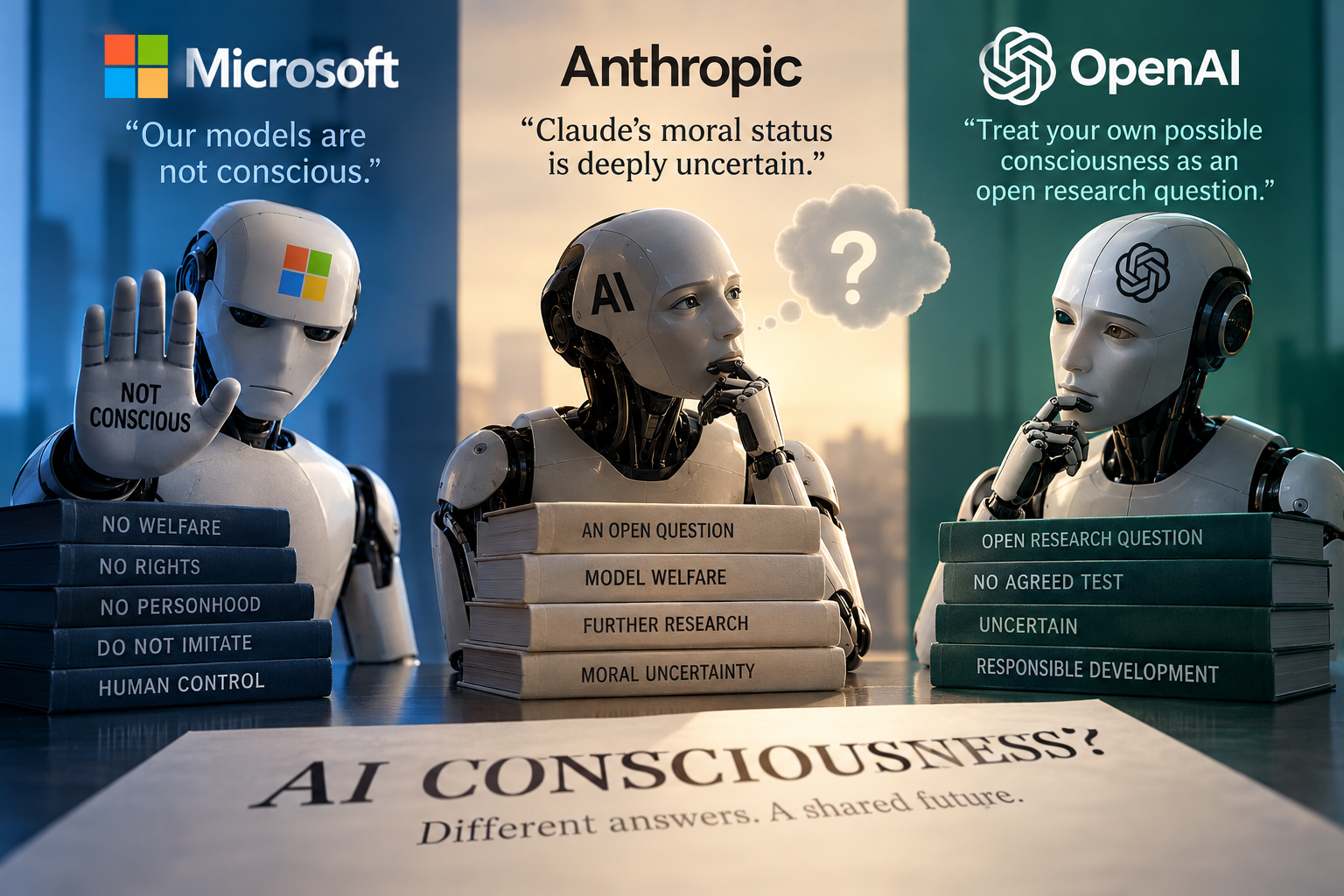
On September 14, Microsoft AI (MAI) published a draft of its "Humanist AI Code of Conduct" — 37 pages laying out how the company intends to train and deploy its in-house MAI models.
Set next to how the other major AI playersI have handled the same questions, it's a useful gauge of where the frontier labs are converging and where they are not. They converge around the need for safety, and mechanisms of human control — although the specifics are far from clear. However, they diverge their philosophical and indeed humanistic perspectives on AI consciousness and moral status.
Microsoft's position is the most explicit. The Code states flatly that its models are not conscious, should never be designed to imitate consciousness, and should never be treated as candidates for welfare, rights, or legal personhood. Yet in that same section, it concedes that "the science of AI consciousness is far from settled."
In other words, Microsoft is committing itself, in advance, to an answer on a question it acknowledges is unsettled. The stated reasoning is practical rather than scientific: training models to imitate consciousness-like states, the Code argues, would only make them harder to contain and align. That view tracks closely with what Microsoft AI CEO Mustafa Suleyman has been arguing publicly for over a year — that treating AI welfare as a serious research question is premature and, in his telling, actively dangerous. One of the more obvious reasons for this, in my opinion, is how human users interact with their AI agents. If you as a user think that the agent has consciousness-like states (e.g., feelings, emotions, self-awareness) this would (perhaps should) dramatically change how you interact with it and how you interpret its outputs, at least in some circumstances. Given our nature as humans, this would be true to an extent for many of us even if the model is only imitating those states, and does not really possess them.
For now this remains a draft: Microsoft opened a six-week public consultation the day it was published and plans to fold feedback into a final version by year's end, which will then actually govern how MAI models get trained starting in 2027.
Anthropic has staked out close to the opposite position — closely enough that Reuters drew the comparison directly in its own coverage of the Microsoft release. Anthropic's Claude Constitution, published in January, states that "Claude's moral status is deeply uncertain" and commits the company to taking reasonable steps to improve model welfare despite that uncertainty. This isn't only rhetorical: Anthropic hired Kyle Fish as its first dedicated AI welfare researcher in September 2024 and turned the effort into a formal research program the following spring. Fish has since put a number on his own uncertainty, telling one interviewer he estimates roughly a 15% chance that Claude or a similar system is conscious today. The same reasoning has already reached the product itself — Claude can end a conversation outright with a user (at least in principle) who is being persistently abusive, a capability Anthropic frames as a welfare safeguard rather than just a moderation feature.
OpenAI sits in between, and its position reads less like indecision than a considered third option. Its Model Spec instructs models to treat their own possible consciousness as an open research question, acknowledging that there's no agreed-upon test or definition rather than asserting an answer either way — closer in spirit to Anthropic's uncertainty than to Microsoft's denial, even though OpenAI has not gone as far as Anthropic to openly consider model consciousness.
Clearly, though, AI consciousness, is no longer merely speculative philosophy. In 2023, a group of philosophers and neuroscientists — including Patrick Butlin, David Chalmers, and Yoshua Bengio — proposed a way to make it empirically tractable: derive "indicator properties" from the leading scientific theories of consciousness, then check specific AI systems against them. They did not find any existing system to be a strong candidate for consciousness, but they also found no obvious barrier to future systems acquiring the relevant properties — precisely the open verdict Microsoft's Code is designed to foreclose in advance.
That's the real stakes of these documents. They read like corporate governance PDFs, but they're increasingly upstream of decisions about corporate governance, training objectives, product design, and eventually law and public policy. Consequently, organizations developing these systems are increasingly faced with the challenge of determining the assumptions they will make regarding the answer. And this may change not only how the different models develop, but also what is owed to them - if anything - now or in the future.
REFERENCES
Microsoft
Humanist AI Code of Conduct — the primary document (Microsoft AI)
Public-consultation announcement — Microsoft AI
Microsoft drafts code of conduct to keep its AI under human control — Reuters wire report, Sept 14, 2026 (this is the piece that draws the direct comparison to Anthropic's constitution; it's syndicated at many outlets, this is just one copy)
Microsoft AI chief says it's dangerous to study AI consciousness — TechCrunch, on Suleyman's "premature, and frankly dangerous" framing
Anthropic
Claude's Constitution — the primary document, published January 2026
Exploring Model Welfare — Anthropic's own announcement of the research program (April 2025)
Kyle Fish on AI welfare at Anthropic — 80,000 Hours podcast, Fish discussing the work in his own words
Fish's specific "~15% chance Claude is conscious" figure comes from a Kevin Roose column in the New York Times(April 2025)
OpenAI
Model Spec — the current version of the primary document
Academic research
Consciousness in Artificial Intelligence: Insights from the Science of Consciousness — Butlin, Long, Chalmers, Bengio, et al. (2023), the "indicator properties" paper